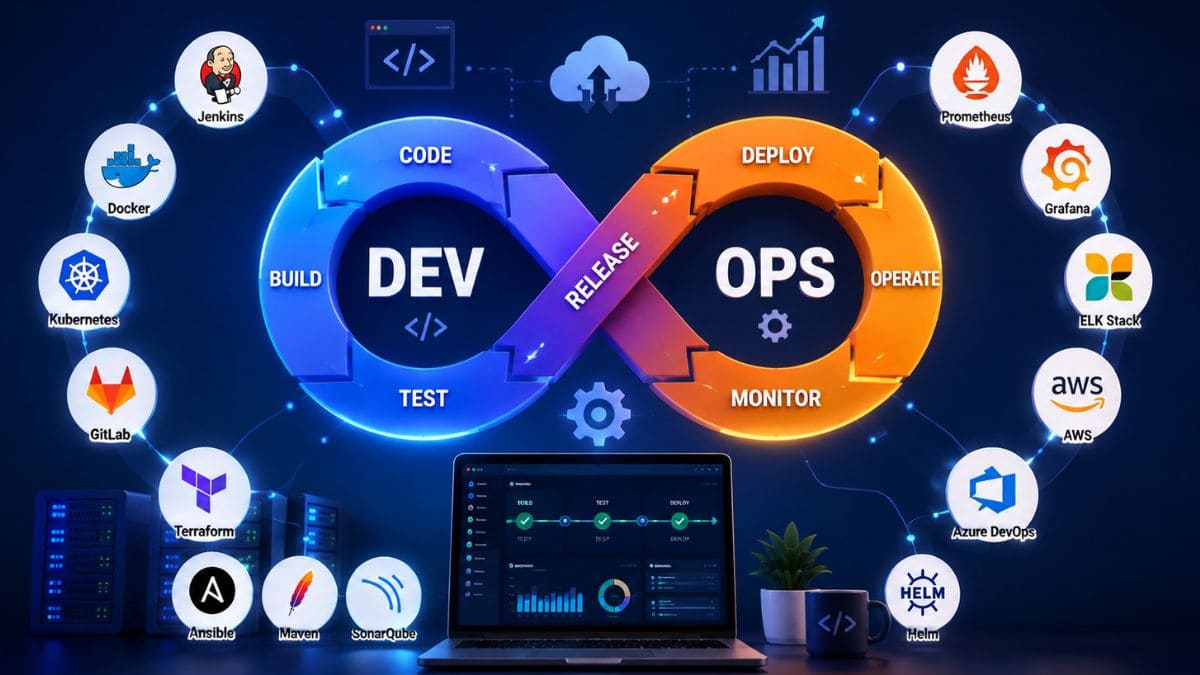
Over the past few years, DevOps tools have become a popular option for development teams aiming to automate and speed up software building, testing, and releasing. When it comes to DevOps tools for development teams, there are many options available for development teams. Whether you are a fresher developer or a specialized professional looking to automate and speed up software and app building, testing, and releasing, DevOps tools could be perfect!
This short guide explores information about the best DevOps tools, including their meaning, core features, and the best options.
DevOps tools are computerized programs designed to help development teams automate and speed up software building, testing, and releasing. Many developers use these tools based on their needs. Key options include Git for code control, Jenkins and GitHub Actions for CI/CD pipelines, Docker for containers, Kubernetes for orchestration, and Terraform for infrastructure setup. Start an Online search to learn more about DevOps tools.
DevOps tools have a range of key features, including:
This feature allows development teams to automatically build, test, and deploy code changes.
It supports teams in launching workflows instantly upon code commits or pull requests.
DevOps tools focus on rollback mechanisms that enable users to revert failed updates automatically to maintain system uptime.
Users can define servers and networks through human-readable configuration files.
Development teams utilize DevOps tools to apply identical system states safely across multiple servers without unexpected drift.
This feature in DevOps tools covers bundling application code with runtime dependencies for environment parity.
This feature allows development teams to manage code histories, branches, and merges seamlessly.
By detecting code vulnerabilities and bugs early in the build cycle, development teams can automate security scanning.
In addition to these core features, Centralized logging, Real-time metrics, and Alert management are other core features.
Here are the best DevOps tools for development teams.
Git is one of the most popular DevOps tools. It tracks code changes and helps teams work on the same project without losing history.
It is the global standard for source code management and team collaboration. You can merge code and roll back errors easily.
It is another DevOps tool for development teams. It packs code and everything it needs into a small box called a container.
It stops the old excuse “it works on my computer.” Containers run the same way on your laptop, test servers, and production. Get started with Docker.
It manages and scales many Docker containers automatically, making it ideal for many teams in development companies.
If your app gets busy, it adds more containers. If traffic drops, it shrinks them down. It keeps large systems online. Read details at Kubernetes.
This tool automates testing and building every time a developer saves new code.
Catches bugs fast and pushes clean updates straight to production without manual clicking. Explore features in GitHub Actions or GitLab CI/CD.
It creates cloud servers and databases using text configuration files, making it a great choice for many teams in development companies.
Instead of setting up cloud web pages by hand, you write code to build your whole system in minutes. Check out Terraform.
Choosing the right DevOps tool requires evaluating your team’s skills, workflow gaps, integration needs, and total cost rather than following market hype. Focus on specific pipeline stages, such as CI/CD, Infrastructure as Code, or observability, to select tools that solve real bottlenecks. Here are the important tips for choosing the right DevOps tool.
Evaluate Integration Capacity
Match Team Expertise
Prioritize Scalability
Calculate Total Cost
Check Community and Support
Selecting the right DevOps tools depends entirely on your team’s specific goals and current bottlenecks. Adopting these tools is more about improving team collaboration than just installing software.
These are just examples of DevOps tools. It is advisable to check all aspects of these tools to make an informed decision. To learn more about these tools, make a search today!